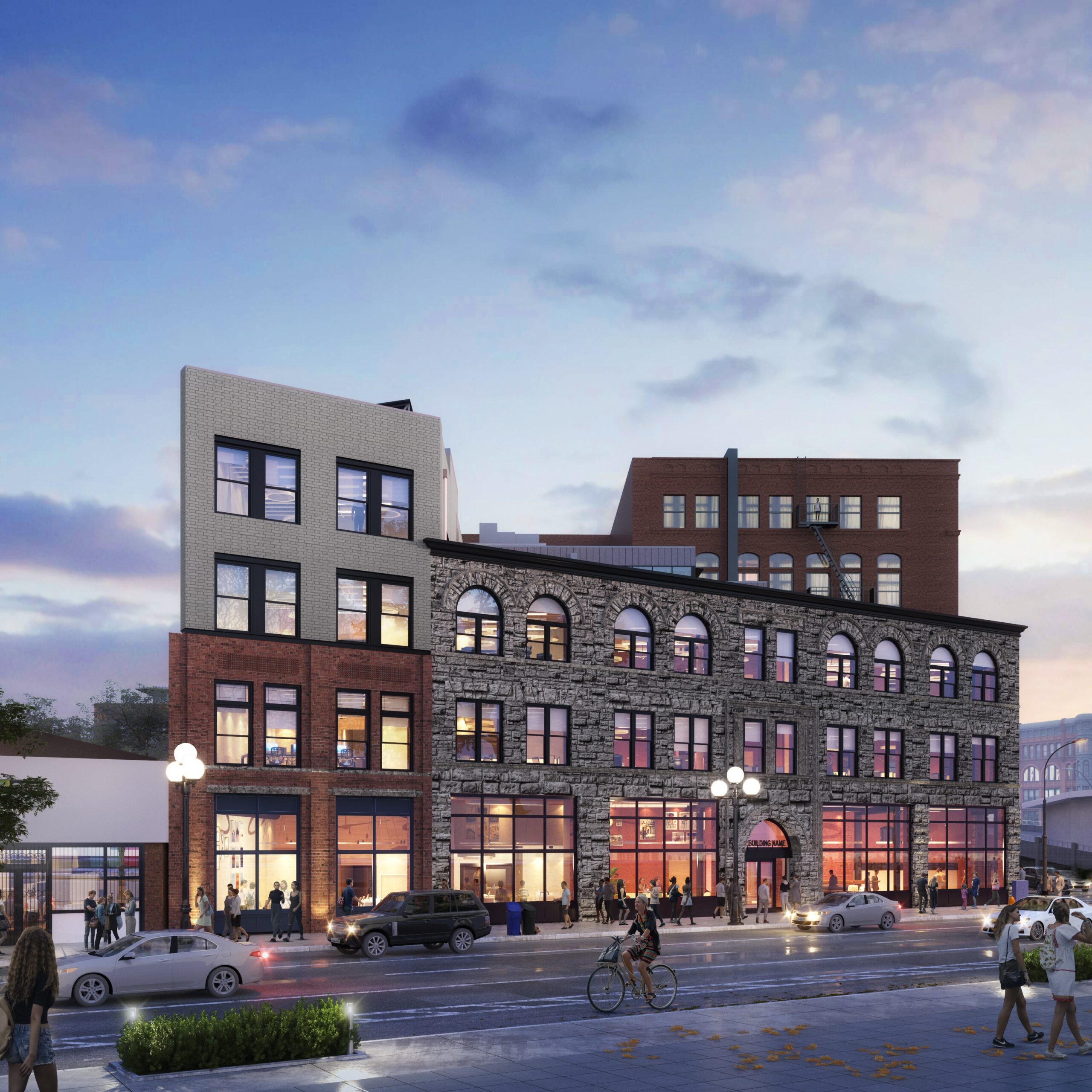
The Metropole’s history
The Metropole was a historic set of two buildings in downtown Seattle at 423 2nd Avenue Ext. S., The Metropole Building and the Busy Bee Building. These two buildings have since been combined into one building, currently called “The Metropole.”
Prior to its current renovation and revitalization, this complex has been in need of development for over a decade.
Original architects
The National Register Historic District Nomination identifies Emil de Neuf, Sr. (1863-1915) as the architect of the Metropole Building, but notes that architectural historians Jeffrey Ochsner and Dennis Andersen have suggested that the design may have been by architect Elmer Fisher (ca. 1843-1905) highly influenced by him. Both men were very well-known for their work throughout the district.
The designer of the Busy Bee building, at 417 Second Avenue Extension S, remains unknown. It is our understanding that Henry Yesler was the first acquirer of the property and commissioned the development of the space.
Early tenants
Guy Drugs was a fixture in the north retail space of the Metropole Building, from 1893 until the early 1970s. Guy was a Seattle police commissioner in the 1890s and at times the commission meetings took place at his store.
During the Klondike Gold Rush, Guy sold a medicine chest especially for prospectors, making his shop a key stopping place.
The early history and ownership of the Busy Building has not been documented. Records indicate that for many years it contained hotel rooms in the upper two floors while the Busy Bee Cafe occupied the first floor, beginning in 1920. Signage for the cafe is visible in tax record photos from 1937, 1950, and 1952, noting “[w]e specialize in sea food.”
A note in the assessor’s record in 1950 indicates that the top two floors were removed under a 1949 permit (likely following damage from the earthquake earlier that year). The record indicates that at that time the second floor was vacant and a cafe and cocktail lounge occupied the first floor. A 1963 photo shows the establishment’s name had changed to the Busy Bee Restaurant.
A historic district
The properties are located within a National Register Historic District as well as a local historic district. A City of Seattle ordinance for the local district was developed initially in 1970, in recognition of the unique social and architectural character of Pioneer Square, and it has since been updated several times.
Specific goals of the district are noted as:
- to preserve, protect, and enhance the historic character of the Pioneer Square area and the buildings therein;
- to return unproductive structures to useful purposes;
- to attract visitors to the City;
- to avoid a proliferation of vehicular parking and vehicular-oriented uses;
- to provide regulations for existing on-street and off-street parking;
- to stabilize existing housing, and encourage a variety of new and rehabilitated housing types for all income groups;
- to encourage the use of transportation modes other than the private automobile;
- to protect existing commercial vehicle access;
- to improve visual and urban relationships between existing and future buildings and structures, parking spaces and public improvements within the area; and
- to encourage pedestrian uses
Building updates over time
Significant changes have been made to both buildings over the past 120 years, on the interior and exterior, but the present buildings retain intact exterior features from the period of significance, which has been established by the National Register nomination of the Pioneer Square Historic District as the eras from the late 1880s up through the early 1930s.
The Metropole building was extensively damaged by fire in May 2007 and rehabilitation was subsequently permitted in 2008. The rehab was started but never completed, leaving the building vacant and in a severe state of disrepair. As such, currently all of the storefront openings are completely covered with plywood, and painted with bold, graffiti-like graphics. On the interior, beautiful brick masonry walls are present throughout the building and make up both the central core and exterior walls on every floor, including the basement, with grand brick arches opening into many of the rooms.
The Metropole, today
In June 2019, spurred on by feedback from its grantee partners who stated that they were being pushed out of the Seattle marketplace due to the high cost of rising rents, the Satterberg Foundation acquired the Metropole with the intention of revitalizing it and to supply office spaces for nonprofit organizations in the area — while still honoring the history of the building.
The Metropole is excited to be a part of the Pioneer Square neighborhood, and we can’t wait to dive further into supporting the community by providing a space for meetings, conversations, learning, collaboration, and trust-building. We look forward to welcoming you!